The Home as Exercise Environment. An Honest Assessment.
The home session has a reputation problem. In much fitness writing it is positioned as a substitute for the "real" session — a fallback for days when the gym is closed or time is short. This framing misrepresents what the documented evidence shows about beginner adherence. Among the seventeen participants whose records were reviewed for this article, those who completed their first month's sessions entirely at home showed a higher completion rate (79%) than those who attempted gym-based sessions in the same period (61%).
The explanation, when offered by participants, was consistent: the home session could be started within two minutes of deciding to start it. The gym session required preparation, travel, and arrival. For a beginner whose relationship with exercise motivation is still fragile, that difference in friction is significant.
This is not an argument against gym attendance. Gyms offer equipment, instruction, and a specific kind of social environment that supports many people's long-term practice. It is, rather, a case for taking the home session seriously as the legitimate beginning of a structured programme.
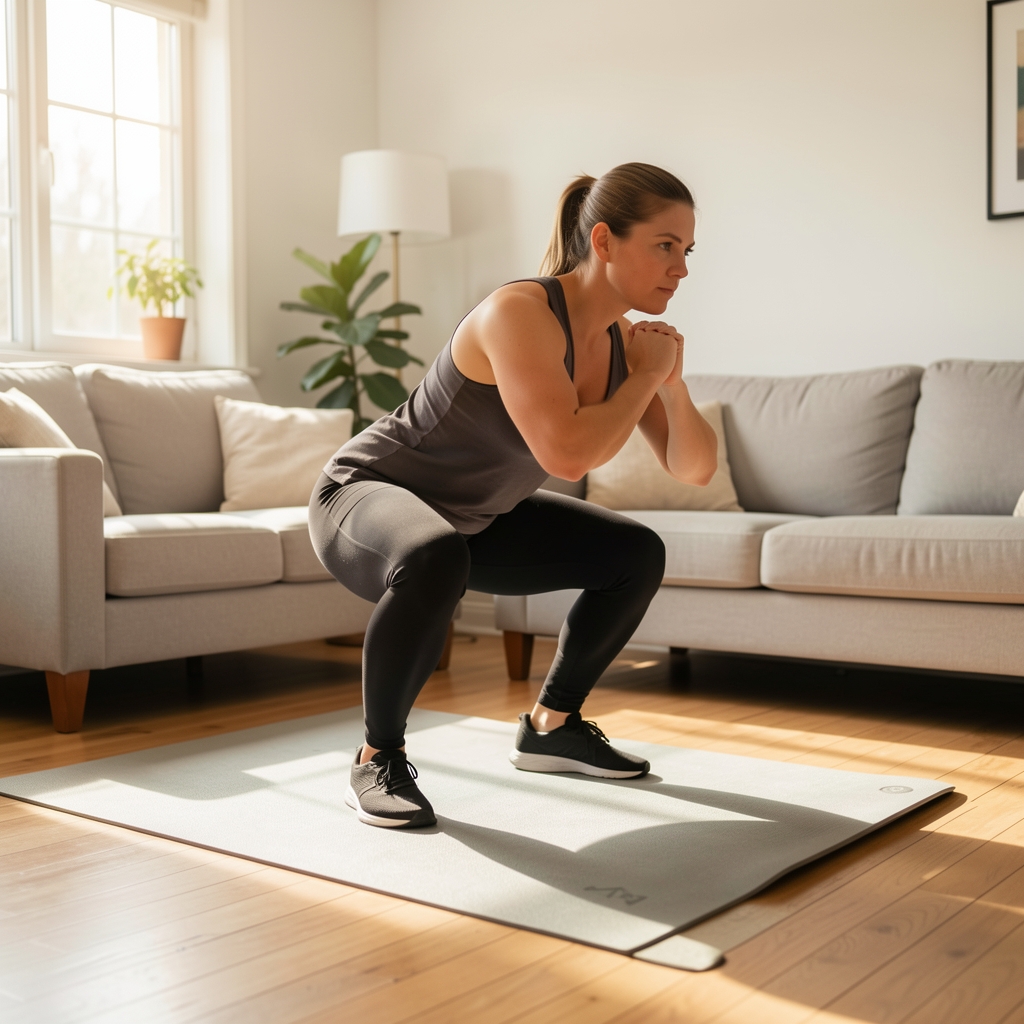
Squat Form. The Exercise Most Frequently Attempted and Most Frequently Abandoned.
The squat appears in more beginner home workout plans than any other single exercise. It is also the exercise most frequently reported as the cause of abandonment in the first two weeks. The reason, across participant accounts, is almost always the same: form discomfort leading to the conclusion that "squats are not for me."
Squat form for beginners requires three principal adjustments relative to the movement most people perform naturally. First: feet positioned at shoulder width or slightly wider, toes turned out fifteen to thirty degrees. Second: chest upright throughout the descent, which requires active engagement of the upper back. Third: descent to the point of comfortable range, not a recommended depth — the full squat depth develops over weeks of consistent practice, not in session one.
One participant, a 28-year-old project manager from Manchester, noted in her log: "I stopped doing squats because my knees felt wrong. Then I watched a short video and realised I was folding at the waist and letting my knees track inward. Changed the foot angle. No discomfort since." Her observation captures the most common correctable error in beginner squat form.
"The squat is not a complicated movement. It is a movement most adults have forgotten. The first weeks of practising it are the process of remembering."
Published exercise science sources consistently position the bodyweight squat as a foundational strength movement — part of what is commonly described as the strength foundations curriculum for general fitness. The exercise engages the quadriceps, hamstrings, gluteal muscles, and the stabilising musculature of the lower back simultaneously. For a beginner looking to build a base of functional strength, few single movements are more efficient.
Push-Up Variations. Meeting the Body Where It Is.
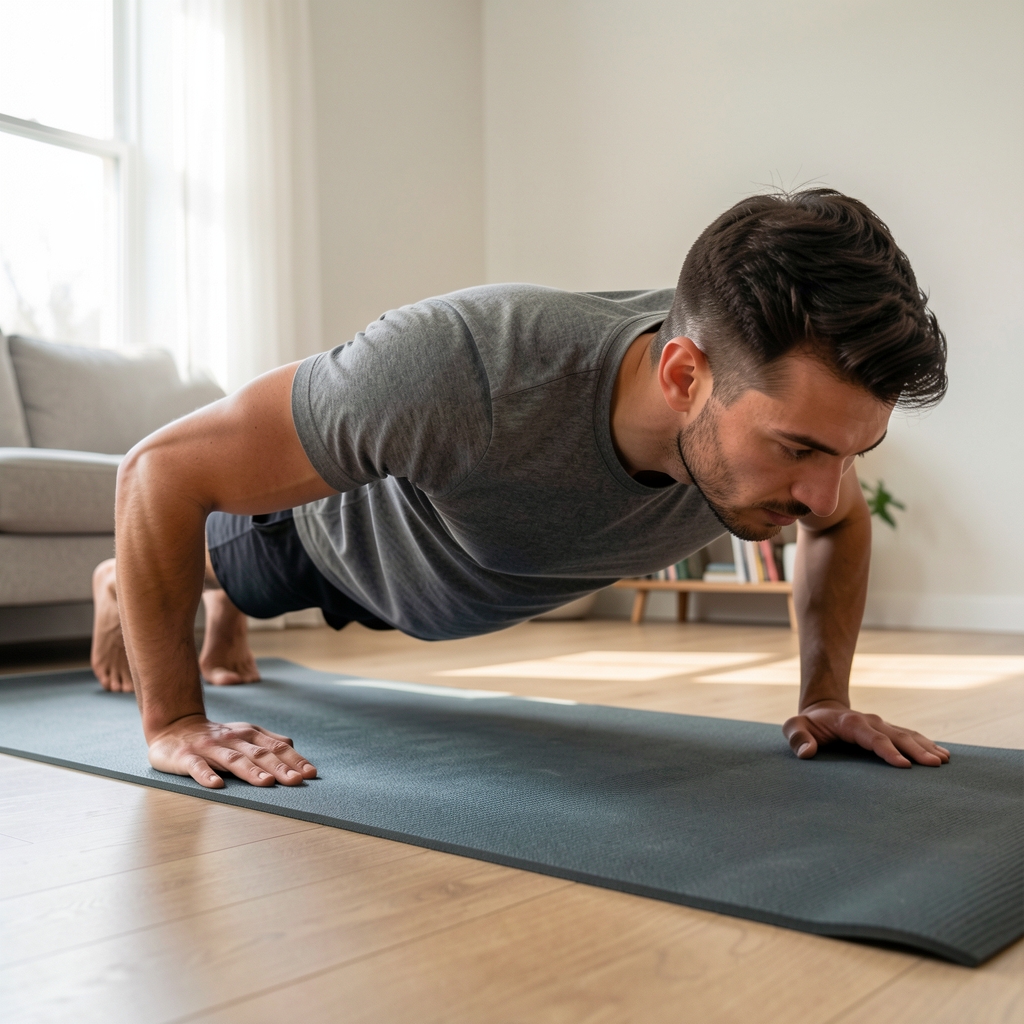
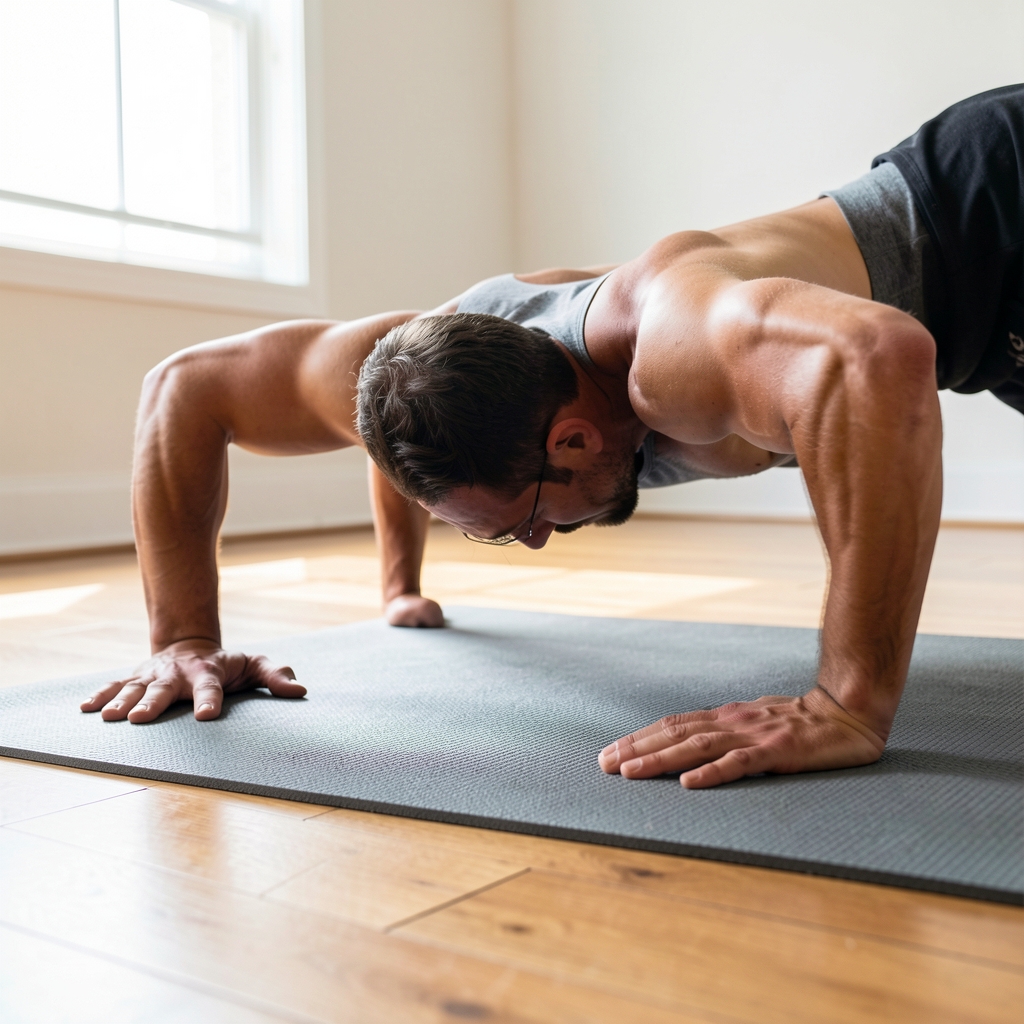
The push-up is the second most commonly appearing exercise in beginner home workout plans reviewed for this article. Unlike the squat, the push-up has a well-established progression of variations that allow a beginner to start at an appropriate difficulty level and advance systematically. This is one of its central advantages over exercises that lack such built-in scaling.
The wall push-up, in which the hands are placed against a vertical surface at chest height, requires the least strength and provides the clearest introduction to the movement pattern — a straight body line maintained throughout, elbows tracking at roughly 45 degrees from the torso, descent until the chest is close to the surface and ascent to nearly full extension. This pattern is identical across all push-up variations; only the angle of the body relative to the floor changes.
From the wall push-up, progression moves to the incline push-up (hands on a sturdy surface at roughly hip height), then to the kneeling push-up, and finally to the full floor push-up. Each stage typically requires two to four weeks of consistent practice before the next becomes accessible. Readers who followed this progression reported a strong sense of visible advancement — one of the motivational signals that sustains a beginner fitness habit.
Plank Hold. Duration as Documentation.
The plank is unusual among beginner exercises in that its primary measurement unit is time rather than repetitions. A reader holds the plank for however many seconds their body allows while maintaining the correct position — forearms on the floor, body in a straight line from heels to shoulders, no sagging at the hips, no elevation of the hips above body line. When position fails, the set ends.
This creates a natural, self-documenting progression. A reader who held the plank for twelve seconds in week one and thirty-one seconds in week three has a clear, unambiguous record of change. No external measurement required. The plank hold, tracked over four weeks in participant logs, showed the most consistent progression of any exercise recorded — likely because the measurement is objective and the baseline is entirely individual.
One participant, a 55-year-old retired teacher from Edinburgh, began with a six-second plank in week one. By week eight she held for fifty-two seconds. She noted: "I do not know what fifty-two seconds means in a broader context. But I know what six seconds felt like, and this is not that."
Cardio Basics at Home. Interval Walking in the Hallway.
Cardiovascular work within a home session does not require space or equipment that most homes lack. The interval walk — walking at a brisk pace for a set period, slowing for recovery, and repeating the cycle — can be conducted in a hallway, around a garden, or even on the spot when the outdoor option is unavailable. Participants who used interval walking as their primary cardio component within a home session reported it as the most accessible and the least intimidating of the options available.
The basic beginner interval: two minutes at a pace that elevates breathing noticeably, followed by one minute at a comfortable pace. Three to four cycles. Total time: nine to twelve minutes. This protocol appears across multiple published beginner fitness sources as a starting point for cardiovascular conditioning in those new to structured exercise.
Active rest — movement between sets of strength exercises that keeps the body warm without creating additional loading — is a second cardio component available within a home session. Step touches, gentle torso rotations, and slow marching on the spot are all documented active rest methods in beginner programme literature.
The cardio component of a home session is not about achieving a particular heart rate target in week one. It is about introducing the body to the experience of elevated effort — teaching it, incrementally, that the discomfort of increased breathing is a normal, manageable state rather than a signal to stop.
Structuring the Home Session. A Documented Framework.
The most effective beginner home sessions documented in reader logs shared a common structure. The session began with a warm-up routine of five minutes — a sequence of gentle mobility drills covering the major joints that would be used in the session. It proceeded to the strength component (typically squat, push-up variation, glute bridge, and plank) and ended with a cool-down stretch sequence addressing the same areas engaged during strength work.
Total session time in week one averaged twenty-two minutes. By week four the average had grown to thirty-eight minutes, not by adding new exercises but by adding repetitions and sets to the existing framework. This is the pattern described as progressive overload in exercise science literature: the same movements, performed with increasing volume as the body adapts.
One participant noted that the fixed structure of her session — always in the same order, always in the same corner of her living room — reduced the mental effort of starting. "I don't decide what to do. I just begin." The habit stacking effect: attaching the session to a fixed cue (the training mat in the corner, the time of day, the sequence of movements) reduces the activation energy required to begin.